According to the Global Waste Management Outlook 2024 published by the United Nations Environment Programme (UNEP), more than 2.3 billion metric tons of municipal solid waste are generated worldwide each year. If current production and consumption patterns remain largely unchanged, global waste generation is projected to increase by approximately 65% by 2050, reaching 3.8 billion metric tons annually.
As the climate crisis intensifies and waste from excessive production and consumption continues to increase, the importance of environmental education is becoming increasingly clear. Environmental education helps people understand the causes and seriousness of environmental issues and encourages them to create meaningful change through small actions in their daily lives.

In response to these growing needs, WeLoveU has continued to provide educational programs that foster a sense of environmental responsibility among global citizens as members of the global community. In the second half of this year, WeLoveU conducted the “Clean WORLD Movement: Emptying the Earth’s Trash Can” program at branches across Korea for middle and high school students, the future leaders of society.
Locations
Seoul, Suwon, Incheon, Seongnam, Daejeon, Asan
Number of Sessions
18
Participants
303
(students from 199 schools)
The environmental education program held in the second half of 2026 was especially meaningful, as it took place after the “Clean WORLD Movement: Emptying the Earth’s Trash Can” was designated an Outstanding Environmental Education Program by the Ministry of Climate, Energy and Environment (Ministry of Environment), under Designation No. 2026-035.
Ahead of the program, refresher training for teachers was held on July 5 at the International WeLoveU Education Center in Seongnam, Korea.

During the training, teachers reviewed key revisions to the educational materials, practiced delivering the curriculum, and exchanged ideas on how to communicate the content more effectively to participants. They also discussed the direction and content of the program so that students could view environmental issues not only in terms of individual actions but also from broader social and structural perspectives. The training helped prepare teachers to lead the youth environmental education sessions in the second half of the year.
Inside the Youth Environmental Education Program
From July 23 to August 30, environmental education sessions for youth were held at 10 branches across Korea. During their school vacation, middle and high school students gathered at each branch to reflect on environmental issues and the future of the planet and share their thoughts with one another.

Rather than relying on one-way lectures, the sessions centered on active participation and discussion. Teachers posed questions that encouraged students to think independently and examine issues from multiple perspectives, while students worked together in groups to discuss how they could respond to environmental challenges.
Students explored the current state of the Great Pacific Garbage Patch (GPGP) and discovered how environmental problems occurring on the other side of the world are closely connected to their own daily lives. They also considered the roles they could play and the actions they could take to help address environmental issues.


What the Data Shows About Environmental Education
The program showed positive changes in students’ awareness of and attitudes toward environmental issues. Pre- and post-program surveys showed improvements across a range of areas, from how students viewed environmental problems to how they reflected on their own lifestyles and consumption habits.
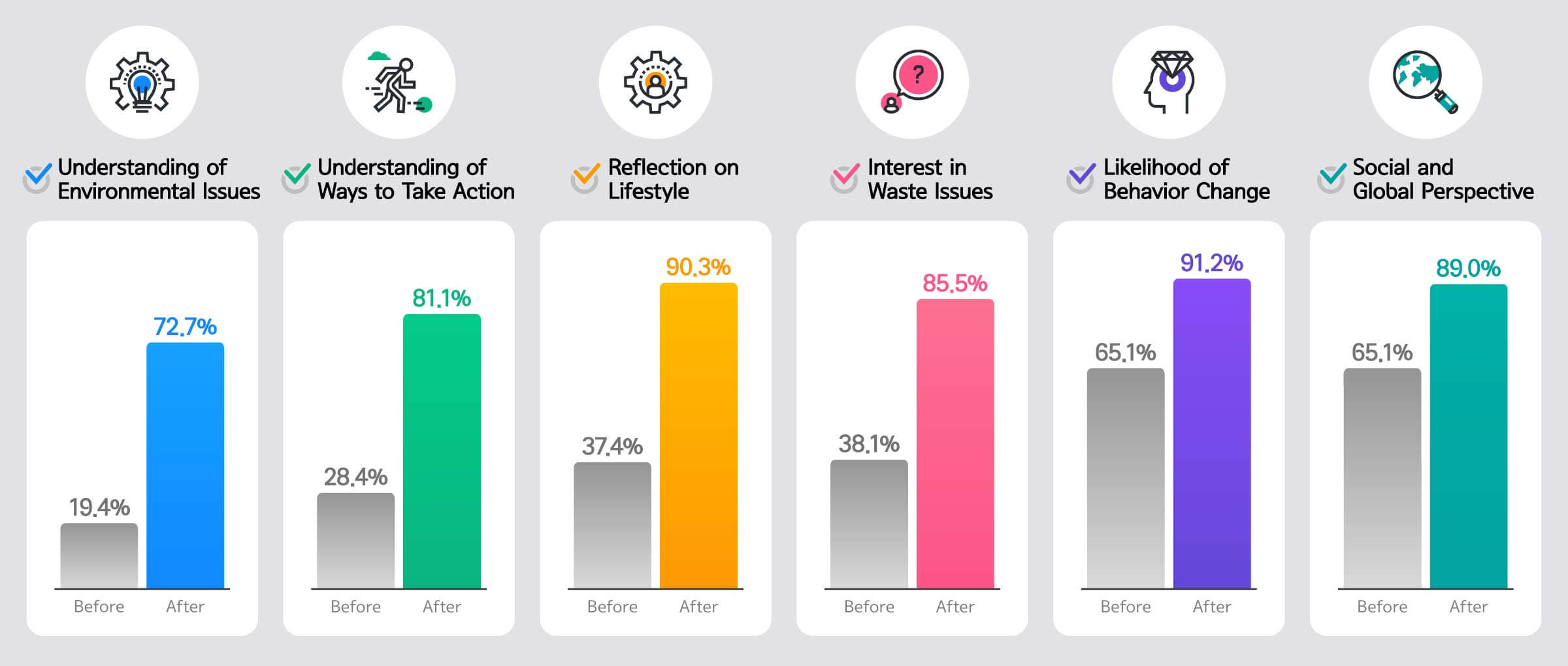
Students’ perspectives on environmental issues also broadened. Rather than seeing them solely as matters of individual responsibility, students came to recognize how they are connected to other people, businesses, and broader social systems.
“I used to think that once trash was out of sight, that was the end of it. But after learning that the waste I throw away can end up in other countries or accumulate in the middle of the Pacific Ocean and form a massive garbage patch, I began to think differently. From now on, I want to be more mindful when disposing of waste and consider the impact it may have.”
Tak Seo-hyeon, Middle School Student (Seoul)
“Until now, I thought of environmental issues mainly in terms of pollution and climate change. Through today’s program, I gained a broader understanding of the various causes of environmental problems and their effects. Above all, I realized that if I want the world to change, I need to start by changing myself. I want to begin with small actions, such as picking up litter at school, and I hope my friends will join me.”
Park Eun-gyu, High School Student (Daejeon)
Students who participated in the program described it as “a turning point that allowed us to think about waste issues from broader and more diverse perspectives.” Realizing that even small actions in their daily lives can affect people and ecosystems on the other side of the world, the students pledged to take part in ecological transition actions—practical steps they can take in their daily lives and communities to help address environmental challenges.

WeLoveU will continue expanding its environmental education efforts so that young people can better understand environmental issues and create positive change wherever they are. We will also support a wider range of educational settings and expand opportunities so that more young people can experience the Outstanding Environmental Education Program designated by the Ministry of Environment.
WeLoveU’s environmental education efforts will continue until people everywhere can enjoy a safe and clean environment.


